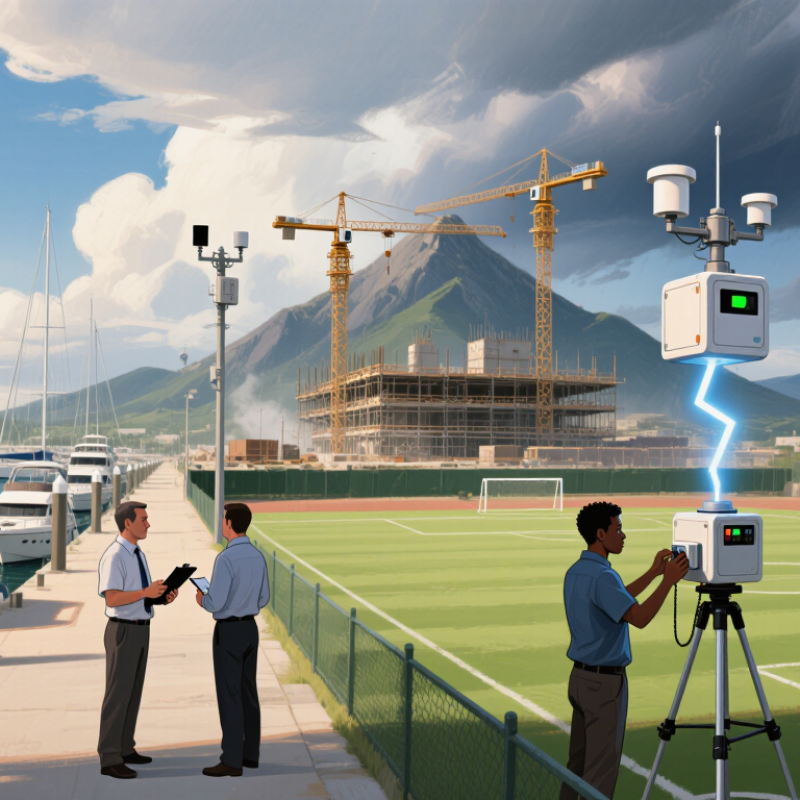
Choosing the right Lightning Alert Device in 2026 requires more than comparing prices or alarm volumes. Global buyers must consider detection range, warning time, installation conditions, maintenance needs, and regional weather patterns. A device suitable for a coastal marina may not perform equally well on a mountain construction site or an open sports field.
Current product categories include portable personal alarms, fixed-site lightning detectors, network-connected monitoring systems, and integrated weather stations. Each type serves a different risk-management purpose. Portable units can support outdoor teams during temporary work. Fixed systems may provide broader coverage around schools, factories, resorts, and public venues. Connected models can send alerts to phones, control rooms, or emergency communication platforms.
Real-world performance depends on more than specifications. Metal structures, terrain, radio interference, battery quality, and poor sensor placement can affect results. Buyers should review independent testing, manufacturer documentation, warranty terms, software support, and local installation requirements. Compliance expectations also differ between countries, so procurement teams should consult qualified safety professionals and relevant authorities.
Not every impressive feature improves safety. A louder siren is not always a better warning. A cloud dashboard may become useless when connectivity fails. This is where practical testing matters. Ask suppliers for measurable detection information, false-alarm data, operating temperatures, and maintenance procedures. Field experience often reveals weaknesses that brochures do not mention.
This guide examines the leading Lightning Alert Device types for global buyers in 2026. It compares their strengths, limitations, deployment environments, and ownership considerations. Some conclusions may remain imperfect because weather technology evolves quickly. Careful evaluation is still better than choosing by marketing language alone.
2026 Top Lightning Alert Device Types for Global Buyers?
Lightning alert devices identify nearby electrical activity and warn people before a storm becomes dangerous. Common types include atmospheric electric-field monitors, radio-frequency detectors, network-connected receivers, and wearable personal alarms. Field monitors measure changes in the air’s electric field. Radio-frequency systems detect electromagnetic signals from lightning strikes. Networked units combine regional weather data with local sensors. Some devices use sirens, flashing lights, mobile notifications, or control-room dashboards.
Their main value is time. A warning can stop a school activity, move workers indoors, or clear a sports field. The World Meteorological Organization reports that lightning causes more than 2,000 deaths worldwide each year. The U.S. National Weather Service also records lightning as a persistent cause of weather-related fatalities. These figures support early warning, but they do not make any device perfect. False alarms may come from electrical equipment, while weak signals can delay alerts. That part needs honest testing.
Buyers should check detection range, alert delay, battery backup, weather resistance, data connectivity, and local installation conditions. A device should support a clear shelter policy, not replace one. Industry field reports often show stronger performance when sensors are correctly positioned and regularly maintained. In practical use, a loud outdoor siren may protect a factory yard, while phone alerts suit traveling workers. No device prevents lightning. It only creates a safer decision window.
2026 Top Lightning Alert Device Types for Global Buyers: How Personal Lightning Detectors Identify Nearby Storm Activity
Personal lightning detectors monitor sudden electromagnetic changes around the user. A sensor may detect radio-frequency pulses from a lightning channel. Some devices also measure local electric-field changes before a strike. Algorithms compare pulse strength, timing, and direction to estimate storm distance. The result is usually an alert, not a perfect forecast.
NOAA’s National Severe Storms Laboratory states that lightning can heat air to nearly 50,000°F. The U.S. National Weather Service says thunder may be heard from about 10 miles away. These figures show why outdoor workers, hikers, and event teams need early warnings. However, a detector can miss distant or weak signals. It can also alert during storm activity outside the selected range. That uncertainty deserves attention.
Tips
Choose a device with a clear detection radius and visible battery status. Test alerts outdoors, away from dense metal structures. Keep the detector near the user, not inside a sealed vehicle. Treat every alert seriously, even when the sky looks bright. A personal detector supports judgment; it does not replace official weather warnings. Check local meteorological guidance before outdoor work. Personal experience matters, but human assumptions can still fail.
How personal lightning detectors identify nearby storm activity
Lightning produces broadband radio-frequency energy that reaches a detector at nearly the speed of light. Thunder travels much more slowly, at approximately 343 meters per second near sea level. The chart compares the arrival time of a lightning radio signal with the approximate time required for thunder to reach the same distance.
2026 Top Lightning Alert Device Types for Global Buyers?
How Outdoor Lightning Warning Systems Monitor and Signal Risk
Outdoor lightning warning systems combine sensors, weather data, and clear alerts. A field mill measures changes in atmospheric electric charge before visible lightning appears. Lightning detection receivers then identify electromagnetic pulses from nearby strikes. According to NOAA guidance, lightning can strike roughly 10 miles from a storm’s rain area. That distance makes early monitoring essential for stadiums, construction sites, ports, and outdoor events.
The best device type depends on the risk scene. A standalone siren suits large, noisy spaces. A strobe and screen help workers who may not hear alarms. Networked systems can send alerts to control rooms, mobile devices, or access gates. The World Meteorological Organization reports that lightning causes more than 2,000 deaths worldwide each year. Reliable systems therefore need layered signals, visible status checks, and battery backup.
A practical warning cycle might begin with a pre-alert, followed by a higher-risk alarm when strikes approach. Operators should define safe shelter distances and clear restart rules. Sensors also need periodic testing, because dust, metal structures, and poor grounding can distort readings. No device predicts every strike perfectly. That is the uncomfortable part. Buyers should review detection range, update speed, alarm volume, ingress protection, and local weather integration, rather than trusting a single impressive specification.
Smart weather stations are becoming practical lightning alert devices for homes, farms, schools, and industrial sites. They combine electric-field sensors, radio-frequency detection, rainfall data, and local pressure changes. When electrical activity rises, the station can send alerts through mobile applications, email, text messages, or nearby alarms.
The World Meteorological Organization reported that weather, climate, and water-related disasters caused over two million deaths and about 3.64 trillion dollars in losses from 1970 to 2019. Lightning is only one hazard, but its rapid development makes local warning valuable. The National Weather Service notes that lightning can heat surrounding air to roughly 50,000°F, creating a sudden expansion and thunder. Smart stations cannot prevent strikes. They can shorten reaction time.
For global buyers, three device types deserve attention: standalone lightning sensors, connected weather stations, and hybrid systems using external detection networks. Standalone units suit remote properties, while connected stations provide broader data and remote monitoring. Hybrid systems may improve coverage, but they depend on network availability and service quality. Terrain, building materials, electromagnetic interference, and sensor placement can affect performance. No station is perfect. A device may detect nearby electrical activity without predicting the exact strike point. Buyers should check published detection ranges, alert latency, calibration records, data security practices, and local communication compatibility before installation. During testing, a visible storm log and a timed alert record are useful, although real-world results may still vary.
Choosing a lightning alert device starts with range, but range is not a simple distance number. NOAA’s National Weather Service warns that lightning can strike roughly 10 miles from rainfall. A device covering only a nearby field may miss danger beyond visible clouds. Check whether the stated range refers to open-air detection, network coverage, or the warning radius around a sensor.
Accuracy also needs careful reading. IEC 62793:2020 separates lightning warning systems by detection methods, including electric-field sensing and lightning-location networks. Electric-field devices can react locally, often before a storm reaches a site. Network systems may provide broader regional information, but mobile signals or data delays can affect alerts. In field use, a clear outdoor installation matters. Metal roofs, tall trees, and nearby electrical equipment can distort local measurements. That detail is easy to overlook.
Use case should guide the final choice. A sports ground may need loud alarms, visible strobes, and rapid local warnings. A farm may value long-range alerts and simple maintenance. Industrial sites often need relay outputs, event logs, and integration with emergency procedures. The World Meteorological Organization emphasizes reliable, timely hazard information within early-warning systems. Still, no device detects every strike perfectly. Test alarms during scheduled drills, record missed or late alerts, and question impressive accuracy claims without independent verification. Safety decisions should not depend on one screen.
| Device Type | Primary Detection Method | Typical Effective Range | Typical Detection Lead Time | Relative Accuracy | Best Use Cases | Main Limitations | Recommended Buyer Priority |
|---|---|---|---|---|---|---|---|
| Electric-Field Mill | Measures changes in the atmospheric electric field caused by charge buildup. | Approximately 0.5–15 km for local warning, depending on installation height, terrain, and atmospheric conditions. | Several minutes to about 30 minutes before nearby lightning when storm electrification is detected. | High for local electrostatic-field trends; it does not directly confirm every lightning strike. | Industrial sites, airports, sports fields, construction areas, mines, and outdoor events. | Sensitive to grounding, nearby structures, terrain, precipitation, and electrical interference. | Choose when early local warning and continuous site monitoring are more important than strike location. |
| VLF/LF Radio-Frequency Lightning Detector | Detects electromagnetic pulses, commonly called lightning sferics, generated by lightning discharges. | Approximately 50–500 km for a standalone regional sensor; coverage can be wider with a connected sensor network. | Usually seconds to a few minutes after a detectable discharge; less effective for pre-lightning warning. | Medium to high for lightning occurrence; location accuracy depends strongly on antenna design and network density. | Large sites, utility corridors, transport operations, weather monitoring, and regional safety systems. | Radio noise, mountains, coastal effects, and a limited ability to predict the first strike. | Prioritize detection speed, network connectivity, interference filtering, and verified location performance. |
| Networked Lightning Location Receiver | Combines time-of-arrival and/or direction-finding measurements from multiple remote sensors. | Typically 100–2,000+ km when supported by a regional or national sensor network. | Near real time, commonly within a few seconds of a detected discharge. | High in well-covered areas; practical location error may range from tens of meters to several kilometers. | National weather services, aviation, power grids, marine operations, and large-scale infrastructure. | Performance falls outside network coverage and may require subscription connectivity or data integration. | Select based on geographic coverage, data latency, location error, uptime, and API compatibility. |
| Optical Lightning Camera | Uses visible-light or near-infrared imaging to identify lightning flashes and illuminated channels. | Approximately 5–30 km in clear line-of-sight conditions. | Immediate detection of visible flashes; generally little or no warning before the first flash. | High for visible events within the camera field of view; classification is affected by daylight, fog, rain, and obstructions. | Critical facilities, research stations, security monitoring, incident verification, and visual documentation. | Cannot reliably detect hidden or distant flashes outside the field of view; requires clean lenses and stable mounting. | Focus on night/day performance, frame rate, low-light sensitivity, weather protection, and field-of-view coverage. |
| Acoustic Thunder Detector | Analyzes thunder pressure waves and acoustic signatures after a lightning discharge. | Approximately 5–50 km, depending on background noise, wind, terrain, and atmospheric conditions. | Usually seconds to several minutes after lightning, depending on distance and sound propagation. | Medium for nearby thunder events; lower in urban or industrial environments with high noise levels. | Low-cost supplementary monitoring, educational sites, farms, parks, and locations without radio coverage. | Noise, wind, buildings, and terrain can reduce detection reliability and distance estimation accuracy. | Use as a secondary confirmation method rather than the sole safety trigger. |
| Hybrid Lightning Alert Station | Combines two or more methods, such as electric-field sensing, RF detection, GPS, weather data, and audible alarms. | Approximately 10–100 km for site-level warning; coverage depends on the sensors and external data sources used. | From several minutes of pre-storm indication to near-real-time strike detection. | High when sensor fusion is properly calibrated and local conditions are accounted for. | Airports, refineries, ports, stadiums, industrial campuses, resorts, and high-risk outdoor operations. | Higher purchase and maintenance cost; incorrect installation or poor calibration can reduce the benefit of multiple sensors. | Prioritize alarm logic, sensor redundancy, data validation, communications resilience, and integration with emergency procedures. |
Build your system. Protect your boat. Join the movement.