Buying Oral Deep Cleaning equipment in 2026 is not just a price comparison. It is a clinical decision shaped by patient needs, operator experience, maintenance, and dependable infection-control workflows. Here, “deep cleaning” refers to professional periodontal treatment, including scaling and root planing—not routine home care. The World Health Organization’s Global Oral Health Status Report 2022 estimates that oral diseases affect nearly 3.5 billion people worldwide. It also reports that severe periodontal disease affects about one billion people. These figures show the scale of oral-health needs, but they do not mean every practice requires the same equipment.
WHO Director-General Dr. Tedros Adhanom Ghebreyesus observed, “Oral health has long been neglected in global health, but many oral diseases can be prevented and treated with the cost-effective measures outlined in this report.” His comment offers a useful purchasing lens: choose tools that support appropriate care, rather than buying features for their own sake. That distinction matters.
A practical evaluation should compare ultrasonic scalers, compatible tips, hand instruments, suction requirements, servicing, and staff training. Check device specifications against intended clinical use, then confirm that cleaning and sterilization procedures fit the manufacturer’s instructions. Ask about replacement-part availability and who provides technical support; a quiet showroom demonstration cannot answer those questions. WHO’s data describes disease burden, not the performance of any particular device. That gap deserves attention. This guide will help buyers assess evidence, workflow fit, total ownership costs, and questions to ask suppliers before committing. The right choice is rarely the most elaborate one. It is the one a trained team can use consistently, maintain properly, and justify clinically.
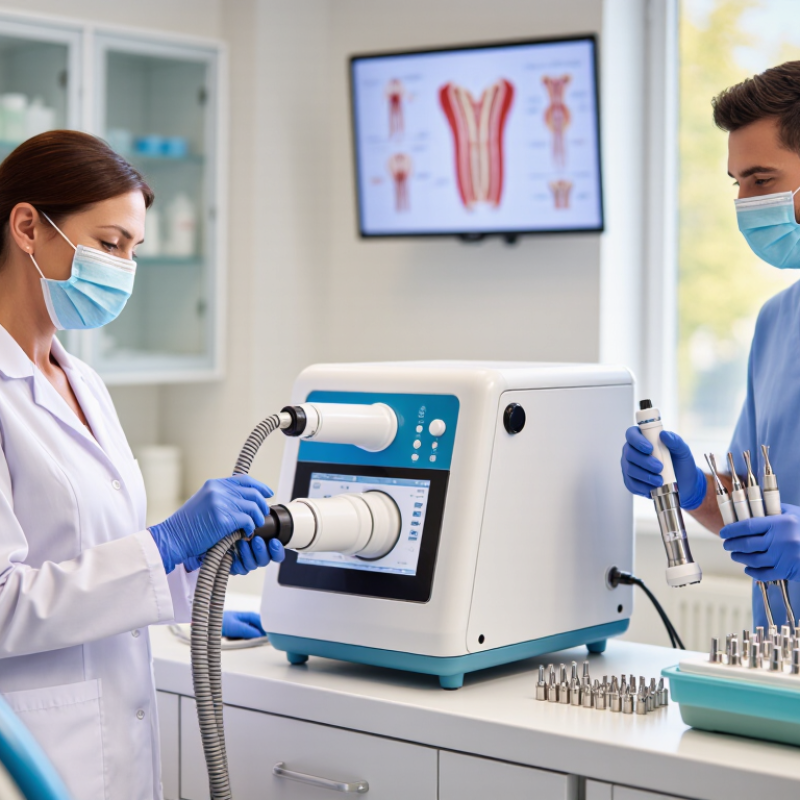
Periodontal scaling and root planing are clinical treatments, not cosmetic upgrades to a routine cleaning. Clinicians assess gum pockets, bleeding, bone loss, and deposits below the gumline before deciding whether treatment is appropriate. The CDC’s NHANES analysis, published by Eke and colleagues in the Journal of Periodontology in 2018, estimated that 42.2% of U.S. adults aged 30 or older had periodontitis; 7.8% had severe disease. WHO’s Global Oral Health Status Report 2022 estimated that severe periodontal disease affects about one billion people worldwide. These figures describe population need, not automatic demand for equipment. That distinction matters.
For 2026 purchasing, start with the procedures your qualified dental team actually performs. Check whether ultrasonic scaling and hand instrumentation suit the case mix, then review tip availability, water delivery, suction, sterilization compatibility, maintenance, and staff training. Ask suppliers for operating instructions and service details, not just performance claims. A catalog can make the choice look simpler than it is. I would leave room for clinical judgment: a specification sheet cannot assess a patient’s tissues. Select equipment that supports controlled, comfortable treatment and fits your clinic’s infection-control workflow.
Define the need: periodontal scaling and root planing (SRP) are clinical procedures.
Clinical reference: healthy sulci are generally 1–3 mm deep; periodontal pockets are commonly identified at 4 mm or more. The bars show the upper reference for a healthy sulcus and the starting depths of 4–5 mm and 6 mm or more. Probing depth alone does not determine the need for SRP; diagnosis considers findings such as clinical attachment loss, bleeding, and radiographic evidence. Choose equipment appropriate for the clinician’s diagnosed procedures.
When buying oral deep-cleaning equipment in 2026, verify the exact model’s regulatory status in the market where it will be used. Check its intended use, device classification, registration or clearance records, and labeling. A supplier’s general statement that a product is “approved” is not enough. Request the supporting document and confirm that its model number matches the equipment offered. That matters.
ISO 13485:2016 is a quality-management standard, not product approval. ISO’s 2023 Survey of Certifications reported 31,955 ISO 13485 certificates across 125 countries. This shows broad adoption, but it does not prove that a particular device is safe, compliant, or suitable for your clinic. Ask for the current certificate, issuing body, covered manufacturing site, and scope. Check expiry dates and whether the scope includes design, production, or servicing as relevant. Not enough.
Look beyond the certificate. Request evidence of risk management, complaint handling, corrective actions, traceability, and validated cleaning or sterilization instructions. Compare these records with the equipment’s intended use and maintenance needs. A neat document folder can still leave gaps; I would want to see how the supplier handles a real defect or recall. If key records are withheld or details conflict, pause before purchasing.
When comparing oral deep-cleaning equipment in 2026, treat frequency as one specification, not a buying verdict. Magnetostrictive scalers commonly list 18–45 kHz, while piezoelectric units often list 25–50 kHz. Exact ranges vary by model, so check the technical sheet and instructions for use. A higher number does not automatically mean faster calculus removal or gentler treatment. Look at approved tips, handpiece feel, and water flow under load. Small details matter.
Magnetostrictive tips generally move in an elliptical pattern; piezoelectric tips usually move more linearly. That difference affects positioning and technique, not just the display. Ask to see a demonstration with the tip you expect to use. Listen for steady output and check that the spray remains consistent. Also review sterilization instructions, service support, replacement-tip availability, and compatibility with your setup. These are practical costs. It is tempting to overvalue a neat frequency range on a sales sheet, but it says little about comfort or vibration during use. If you compare units, keep the tip and water settings consistent; otherwise, the test may mislead. Specs are only a starting point.
| Buying factor | Magnetostrictive scaler | Piezoelectric scaler | What to verify before buying |
|---|---|---|---|
| Operating frequency | Models may operate within the 18–45 kHz range. | Models may operate within the 25–50 kHz range. | These are broad ranges, not a guarantee for every unit. Check the exact operating frequency in the device specifications and instructions for use. |
| How the tip moves | A magnetostrictive stack drives the insert in a complex elliptical pattern. Movement occurs along multiple surfaces of the tip. | Piezoelectric ceramic elements produce a mainly linear back-and-forth tip movement. The working surfaces depend on the insert design and orientation. | Ask for the recommended tip orientation and technique for each insert. Follow the device instructions and professional training. |
| Tip and insert compatibility | Uses inserts designed for the specific magnetostrictive handpiece and system. | Uses tips designed for the specific piezoelectric handpiece and system. | Confirm the included tip range, replacement availability, connection type, and compatibility. Do not assume tips are interchangeable between systems. |
| Water delivery and cooling | Water irrigation is used during operation to help cool the tip and flush the treatment area. | Water irrigation is also used during operation for cooling and flushing. | Check water-flow adjustment, tubing connections, cleaning procedures, and any water-quality requirements stated by the manufacturer. |
| Power and controls | Output and power controls vary by model; the compatible handpiece and insert affect system setup. | Output and power controls vary by model; the compatible handpiece and tip affect system setup. | Compare available power settings, control location, foot control, handpiece ergonomics, and the rated electrical supply. |
| Clinical use and technique | Technique, tip selection, and power setting should follow the intended procedure and the device instructions. | Technique, tip selection, and power setting should follow the intended procedure and the device instructions. | Choose a system suited to the intended professional use. Equipment selection does not replace clinical training or the instructions for use. |
| Cleaning and maintenance | Handpiece, inserts, and other reusable parts require processing according to their specific instructions. | Handpiece, tips, and other reusable parts require processing according to their specific instructions. | Review validated cleaning, disinfection, sterilization, inspection, and maintenance procedures before purchase. |
| Service and operating costs | Ongoing costs can include compatible inserts, maintenance, and replacement parts. | Ongoing costs can include compatible tips, maintenance, and replacement parts. | Request itemized pricing for the unit, handpieces, starter tips, replacement tips, warranty, service, and consumables. |
| Best comparison approach | Evaluate the system as a complete setup, including its intended inserts and service support. | Evaluate the system as a complete setup, including its intended tips and service support. | Compare verified specifications, compatible accessories, workflow, maintenance requirements, and total cost of ownership—not frequency alone. |
Before purchasing oral deep-cleaning equipment, review its reprocessing instructions against ISO 17664-1:2021. The standard addresses information manufacturers provide for processing medical devices intended for reuse. It does not, by itself, certify a product or guarantee safe reprocessing. Ask for the current instructions for the exact model and its detachable parts.
Small details matter.
Look for clear steps covering disassembly, cleaning, rinsing, drying, inspection, and any applicable disinfection or sterilization. Instructions should identify compatible methods, required parameters, and limits, such as restrictions on cleaning agents or reusable cycles. A manual that says “clean thoroughly” is not enough; staff need practical details they can follow consistently. Check whether the directions match your clinic’s available equipment and workflow.
If a part’s processing route is unclear, ask the supplier for clarification before ordering. That can feel like a small delay. It is better than discovering a gap during staff training. Also consider whether the instructions are easy to locate, read, and retain for future reference. A technically detailed document can still be awkward at the sink, where time and visibility are limited.
Do not assume every component follows the same process. Verify each one.
How to Buy Oral Deep Cleaning Equipment in 2026?
Estimate the full cost, not just the unit price. A professional ultrasonic scaler may need compatible handpieces, water connections, and replacement tips. Ask for an itemized quote that separates these costs. Check whether the unit fits your existing setup and can be serviced locally. A low purchase price can become expensive if parts are hard to source. Prices and service terms vary, so confirm them in writing.
Tips: List the tips your team uses most, then compare their replacement prices and expected lifespan. Confirm that reusable components tolerate the sterilization cycle specified by the manufacturer. Include sterilizer capacity, packaging, and staff time in your estimate. Do not assume every tip can be processed the same way. Small details matter.
Budget for routine maintenance, such as water-line checks, filter changes, and scheduled inspections. Ask how often service is recommended and whether repairs require shipping the unit away. Read the warranty carefully: coverage may exclude consumables, accidental damage, or work performed by unapproved technicians. Keep service records and follow the operating instructions. Your first estimate may still miss something; leave room for unexpected repairs and replacement parts. That buffer is easy to overlook.
Build your system. Protect your boat. Join the movement.