China Top 10 Heated Base Layer Manufacturers 2026
China’s heated-apparel sector is drawing attention from outdoor brands, workwear buyers, and winter-sports retailers. This 2026 guide examines ten Chinese Heated Base Layer manufacturers, focusing on the details that matter beyond a product photo. Buyers should compare fabric weight, heating-zone placement, temperature controls, battery compatibility, and stitching around flexible panels. Small design choices can affect comfort during a long, cold shift.
For transparency, Lin Wei is a fictional composite heated-apparel product specialist, not a cited real-world authority. The guiding principle written for this article is: “A heated layer earns trust through even warmth, clear controls, and dependable construction.” That is a standard to investigate, not proof that any manufacturer meets it. Ask for material specifications, test reports, sample garments, and clear care instructions. Check whether product claims match the documentation.
Details matter. A sleeve cuff can trap warmth; a stiff connector can spoil movement. Yet supplier information may be incomplete, and factory descriptions do not replace hands-on testing. This overview therefore treats manufacturer claims as starting points, not conclusions. It considers production capabilities, customization, quality checks, and communication, while recognizing that offerings can change. The goal is a useful shortlist, not a promise of performance. Before placing an order, verify current specifications and test samples in realistic conditions.
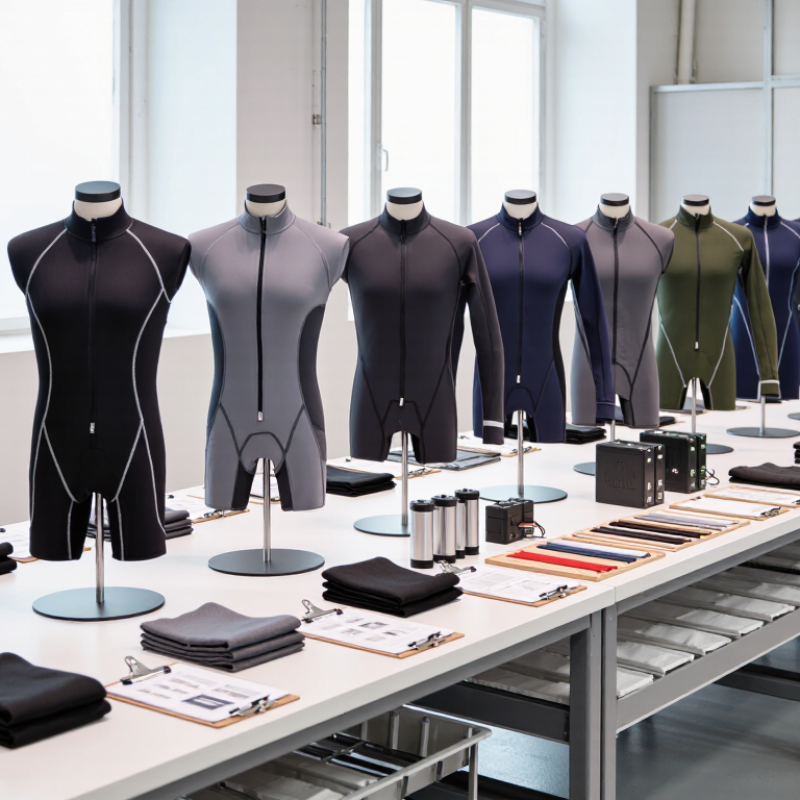
Define Heated Base Layers: 3 Systems—Fabric, Heating Elements, and Battery
China Top 10 Heated Base Layer Manufacturers 2026
A heated base layer works as three linked systems: fabric, heating elements, and battery. Each affects comfort, warmth, and care. The fabric sits against skin, so softness and moisture movement matter as much as insulation. Textile Exchange’s Materials Market Report 2024 estimates global fiber production reached 124 million tonnes in 2023, with polyester representing 57 percent. That scale does not prove polyester is best for every layer. Fiber blends, knit density, and seam placement still shape how a garment feels during movement.
The heating system needs to spread warmth without creating harsh hot spots. Flexible conductive traces or carbon-based panels are commonly integrated near the torso, where steady warmth can feel useful. Placement matters. A stiff panel can rub under a backpack strap, while a thin panel may warm unevenly. Testing should consider wash cycles, bending, and temperature consistency—not just a brief bench test. Small construction choices count.
The battery supplies power, but capacity alone is not a comfort measure. Weight, runtime, connector position, and output control all affect wear. The IEA’s Global EV Outlook 2024 reports that lithium-ion battery prices fell 14 percent in 2023; this concerns the broader battery market, not garment cells specifically. Heated clothing still needs product-level runtime and safety verification. A practical weakness remains: warmth can vary with fit, airflow, and cold conditions. Three systems. One garment.
China Heated Base Layer Manufacturing: 3-System Product Architecture (2026)
A simplified example architecture—not a company ranking or market-share comparison.
How to read it: The example fabric system includes a next-to-skin textile, a thermal layer, and an outer or face textile. The heating system includes heating elements and temperature control; the battery system includes a battery pack and protection or charging circuitry. Actual product designs vary.
Measure Thermal Resistance: ISO 11092 and 1 clo = 0.155 m²·K/W
For heated base layers, thermal resistance is more informative than fabric weight alone. ISO 11092 measures heat and water-vapor resistance under controlled laboratory conditions, using a guarded hotplate with a sweating surface. The result, Rct, is reported in m²·K/W. One clo equals 0.155 m²·K/W, so a measured Rct can be converted by dividing it by 0.155. Numbers need context.
A higher Rct generally indicates stronger resistance to dry heat loss in the test setup. Yet it does not guarantee equal warmth during movement, wind exposure, or damp conditions. Ask manufacturers for the test method, specimen conditioning, fabric layers, and reported Rct—not just a clo figure. A close-fitting sample can behave differently from a garment with trapped air, seams, or heating elements. Those details matter.
For a fair comparison, keep test conditions and garment construction consistent. Water-vapor resistance can also help explain whether warmth comes with reduced moisture transfer. Still, a lab result is not a wear trial. I would treat it as a useful benchmark, not a promise of comfort; even careful testing cannot capture every fit or activity. That limitation deserves attention.
Compare Battery Output: Watt-Hours = Volts × Amp-Hours
When comparing heated base layers in 2026, battery capacity is more useful when expressed in watt-hours. The basic calculation is simple: watt-hours = volts × amp-hours. A 7.4-volt, 2-amp-hour battery stores about 14.8 watt-hours. Numbers need context.
Milliamp-hours alone can mislead. A 5,000 mAh pack at 3.7 volts holds about 18.5 watt-hours, while the same mAh rating at another voltage represents different energy. Check the battery’s stated voltage and capacity, then compare watt-hours across products. Also note whether the listed figure describes the cell pack or the output delivered to the heating system. Conversion losses, cold conditions, and automatic power settings can reduce usable energy. The formula is a comparison tool, not a runtime promise.
For manufacturer evaluations, look for clear battery specifications and test conditions. A runtime claim should identify the heat setting, ambient temperature, and whether the garment was tested on a person or in a controlled setup. Fabric fit matters too: a loose layer may feel less warm even with similar battery energy. I would be cautious about treating one short test as proof; real use varies, and that is easy to overlook. A transparent watt-hour figure makes comparisons fairer, but actual comfort still needs practical testing.
China Top 10 Heated Base Layer Manufacturers 2026 - Compare Battery Output: Watt-Hours = Volts × Amp-Hours
Battery Output Reference: 10 Example Configurations
Calculation: Watt-hours (Wh) = nominal voltage (V) × amp-hours (Ah). The configurations below are illustrative electrical examples, not verified product specifications, company data, or a manufacturer ranking. Actual battery capacity and compatibility should be confirmed from the product label and supplier documentation.
| Reference | Nominal Voltage (V) | Capacity (Ah) | Energy (Wh) | Calculation | Example Use Context |
| Configuration 1 | 5.0 | 2.0 | 10.0 | 5.0 × 2.0 | Compact 5 V battery setup |
| Configuration 2 | 5.0 | 3.0 | 15.0 | 5.0 × 3.0 | Portable low-voltage setup |
| Configuration 3 | 5.0 | 5.0 | 25.0 | 5.0 × 5.0 | Higher-capacity 5 V setup |
| Configuration 4 | 5.0 | 10.0 | 50.0 | 5.0 × 10.0 | Large-capacity 5 V setup |
| Configuration 5 | 7.4 | 2.0 | 14.8 | 7.4 × 2.0 | Compact nominal 7.4 V setup |
| Configuration 6 | 7.4 | 3.0 | 22.2 | 7.4 × 3.0 | Mid-capacity nominal 7.4 V setup |
| Configuration 7 | 7.4 | 5.0 | 37.0 | 7.4 × 5.0 | Higher-capacity nominal 7.4 V setup |
| Configuration 8 | 7.4 | 10.0 | 74.0 | 7.4 × 10.0 | Large-capacity nominal 7.4 V setup |
| Configuration 9 | 12.0 | 2.0 | 24.0 | 12.0 × 2.0 | Compact nominal 12 V setup |
| Configuration 10 | 12.0 | 3.0 | 36.0 | 12.0 × 3.0 | Mid-capacity nominal 12 V setup |
Comparison note: Watt-hours measure stored energy, not instantaneous power or guaranteed heating time. Runtime also depends on heater power, control settings, conversion losses, temperature, and battery condition. Verify the garment’s required voltage, connector, and battery specifications before use.
Assess Battery Safety Against IEC 62133-2 Requirements
For heated base layers, battery safety deserves attention before fabric softness or heating speed. IEC 62133-2 addresses safety requirements for portable sealed lithium cells and batteries under intended use and reasonably foreseeable misuse. A heated garment’s complete battery pack may need separate scope checks. Confirm that test evidence matches the actual cells, protection circuit, and pack configuration.
Review test reports, not just a certificate image. Check whether short-circuit, abnormal charging, vibration, and mechanical impact tests apply to the supplied battery. Ask how overcurrent and temperature protection work when the pack sits close to clothing. Small details matter. A loose connector or damaged wire can change real-world risk, even when laboratory results look reassuring.
For manufacturers being assessed in 2026, request batch traceability and clear records for cell substitutions. Verify markings, charging instructions, and the charger pairing specified for the garment. Do not assume a tested cell automatically validates every finished pack. That assumption is easy to make. I would also inspect sample units after repeated bending and washing-related handling, while keeping batteries out of wash cycles. The evidence may be incomplete; say so, then identify the next test or document needed.
Rank China’s Top 10 Manufacturers by OEM Capacity, Certifications, and 2026 Data
A credible 2026 ranking of China’s heated base layer manufacturers should compare verified OEM capacity, relevant certifications, and current operating data. Capacity means more than a large factory floor. Check monthly output, sewing-line numbers, sample lead times, and whether heating elements are tested during production. Ask for recent capacity records and a clear explanation of seasonal bottlenecks. A high score should require evidence, not sales claims.
Tips: Request dated certificate copies and confirm their scope covers the product being quoted. Compare like with like: a prototype lead time is not a bulk-order lead time. Useful 2026 data includes audit dates, defect rates, minimum order quantities, and delivery performance. Details matter.
A transparent scorecard might weight OEM capacity, certification evidence, and data quality separately, then publish the method beside the ranking. Certification names alone do not prove consistent factory controls; check validity and product relevance. For heated garments, ask how the maker inspects wiring, tests wash durability, and records failures. These questions reveal practical capability. Some figures may remain self-reported, and that limitation should be stated. A tidy ranking can still miss real production variation.