What is Dry Granulation and How Does It Work?
In the realm of pharmaceutical manufacturing, "Dry Granulation" stands out for its efficiency and innovation. Leading industry expert Dr. Jane Smith notes, "Dry granulation is pivotal for optimizing tablet compression and enhancing drug solubility." This process involves creating granules without the use of liquid binders, which minimizes cost and complexity.
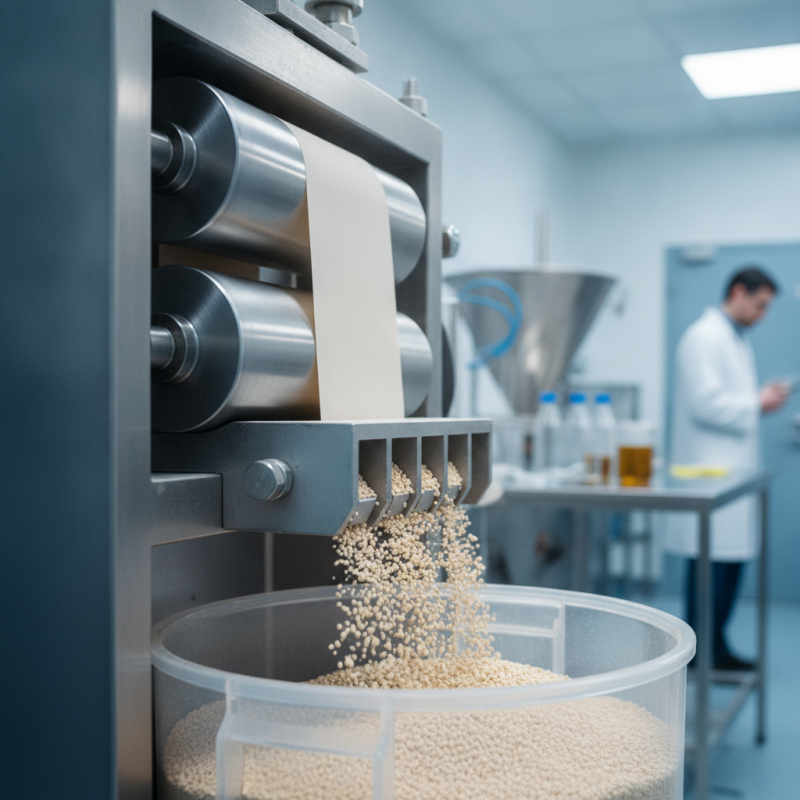
Dry granulation utilizes pressure to form granules from powders. This technique is particularly beneficial for heat-sensitive materials that could degrade with wet granulation methods. By incorporating a roller compaction process, manufacturers can achieve desirable particle sizes that improve flow properties and uniformity.
However, challenges do exist. For instance, achieving the optimal granule size and density can be difficult. Inconsistent pressure during compaction may lead to varying qualities. As the industry progresses, addressing these issues is essential for maximizing the potential of dry granulation. The potential benefits warrant further exploration and innovation in this essential manufacturing method.
Definition of Dry Granulation and Its Importance in Manufacturing
Dry granulation is a process used widely in the manufacturing industry, especially in pharmaceuticals. It transforms fine powders into granules without using liquid binders. This method relies on the application of pressure to compact the powder, creating a dense mass that can be broken down into granules. This approach has several advantages, including improved flow properties and enhanced stability.
The importance of dry granulation lies in its efficiency and capability to handle sensitive materials. Many active pharmaceutical ingredients are moisture-sensitive, making wet granulation unsuitable. By avoiding solvents, dry granulation maintains the integrity of the ingredients. Additionally, it minimizes processing time, reducing costs in production. Companies often overlook the potential drawbacks, like the need for specialized equipment or the possibility of inconsistent granule sizes. Even minor variations can impact drug effectiveness.
Understanding the dry granulation process is critical for manufacturers. It requires careful control over the applied pressure and the characteristics of the starting materials. While it offers several benefits, such as scalability and efficiency, it also demands expertise to ensure quality outcomes. Thus, operators must stay vigilant and continuously refine their techniques.
What is Dry Granulation and How Does It Work? - Definition of Dry Granulation and Its Importance in Manufacturing
| Aspect | Description |
| Definition | Dry granulation is a method of granulating powder without the use of water or solvents, typically through compaction. |
| Process Steps | 1. Powder Mixing 2. Compaction 3. Milling 4. Sieving |
| Advantages | - Reduction of production time - Improved product stability - No drying step required |
| Applications | - Pharmaceutical industry for tablet production - Food industry for powdered ingredients - Chemical products |
| Disadvantages | - Limited to certain materials - Potential for segregation of particles |
| Key Equipment | - Roller compactor - Granulator - Universal mill |
| Importance in Manufacturing | Improves yield, enhances flowability, and ensures uniformity in product characteristics, crucial for quality control. |
The Process of Dry Granulation: Step-by-Step Breakdown
Dry granulation is a critical process in pharmaceutical and food industries. This method allows for efficient production of granules without the use of moisture. The granulation process begins with blending the powder ingredients. This is essential to ensure uniformity in the final product.
Once the powders are mixed, the next step involves compaction. A roller compactor is often employed to compress the powder into larger, denser pieces. Industry reports indicate that this step increases the particle size and improves flowability. However, careful control is needed. Over-processing can lead to undesirable sizes and properties.
After compaction, the material is milled to break down the compacted sheet into granules. The size and uniformity of these granules significantly affect tablet formulation. Approximately 30% of the final product's quality relies on the granulation process. Missteps during any phase can impact compressibility and dissolution rates, thus highlighting the need for precision and control in dry granulation.
Equipment Used in Dry Granulation: Key Machinery and Tools
In dry granulation, specific machinery plays a crucial role in achieving the desired particle characteristics. Key equipment includes the roller compactor, which compresses powders into sheets or flakes. This compacting process ensures uniformity and density in the resulting granules. The flakes are then broken down into granules using a milling machine.
Additionally, size reduction and classification equipment are vital. For instance, a sieve or classifier ensures that granules meet specific size requirements. If the granules are not uniform in size, it can affect the final product. Proper maintenance of these machines is essential to avoid operational inefficiencies.
Tips: Always monitor the moisture content of raw materials. High moisture can lead to clumping, affecting granule formation. Ensuring adequate cleaning of equipment after each use prevents contamination. Regularly inspecting the machines can help identify issues early, preventing costly failures.
Advantages and Disadvantages of Dry Granulation
Dry granulation is a process widely used in the pharmaceutical and food industries. It involves compacting powder into granules without the use of liquid binders. This method has its pros and cons.
One significant advantage of dry granulation is its efficiency. It requires fewer processing steps, reducing the time required for production. This can translate into cost savings for manufacturers. Additionally, the absence of moisture in the process minimizes the risk of degradation of moisture-sensitive ingredients, which is crucial in many formulations. The resulting granules often exhibit improved flow properties, making them easier to handle during tablet manufacturing.
However, there are challenges associated with dry granulation. Not all powders are suitable for this method. Some materials may not compact well, leading to inconsistent granule size and quality. This inconsistency can affect the final product's performance. Another consideration is the potential dust generation during the process, which can pose health risks for workers. Proper ventilation and safety measures are essential to address these concerns. Therefore, while dry granulation offers unique benefits, careful evaluation is necessary to determine its suitability for specific applications.
Applications of Dry Granulation in Various Industries
Dry granulation is widely applied in various industries, particularly pharmaceuticals and food processing. In pharmaceuticals, it enhances the flowability of powdered ingredients. This method creates granules that are easier to handle during manufacturing. It also helps in improving the bioavailability of active ingredients in tablet formulations.
In the food industry, dry granulation is used for creating flavoring agents and nutritional supplements. The process ensures that ingredients are evenly distributed. For example, powdered vitamins can be granulated to improve their stability and mixing with other powders. However, controlling moisture during this process can be a challenge.
Despite its advantages, dry granulation isn't always perfect. Sometimes the granules might not form as expected. The resulting inconsistency can lead to variations in product quality. Manufacturers must continuously refine their processes and equipment to avoid these issues. Regular training for operators is also essential, as proper handling directly impacts the final product.