Top 10 Fiber Opening and Pillow Filling Machines for Buyers
Selecting the right Fiber Opening And Pillow Filling Machine can shape product quality, labor needs, and daily output. A buyer should look beyond headline capacity. Fiber type, opening consistency, filling speed, and cleaning access all matter on the factory floor.
Watch the fiber move.
A stable opener separates clumps without leaving excessive dust or uneven tufts. At the filling station, operators need clear controls, a reachable emergency stop, and a nozzle that directs fiber into the pillow without constant adjustment. Ask suppliers for a live demonstration using your own fiber, if possible. Compare the finished pillows by weight, loft, and feel—not only by machine speed.
The “top 10” machines in this guide are considered through practical buyer criteria: output range, automation, changeover time, maintenance access, and service support. A compact workshop may value a small footprint and simple controls. A larger plant may need continuous feeding and predictable throughput. Neither option is automatically better.
Expert quotations require careful sourcing. No named specialist or verifiable quotation was provided for this draft, so I will not invent one. That is a limitation worth fixing before publication. A buyer-facing expert statement should come from a named professional whose role and original wording can be checked.
This guide aims to help buyers ask sharper questions, compare specifications, and spot trade-offs before requesting a quotation. Specifications still need confirmation with each manufacturer. A polished brochure cannot replace a fiber test, a clear warranty, or a realistic service plan.
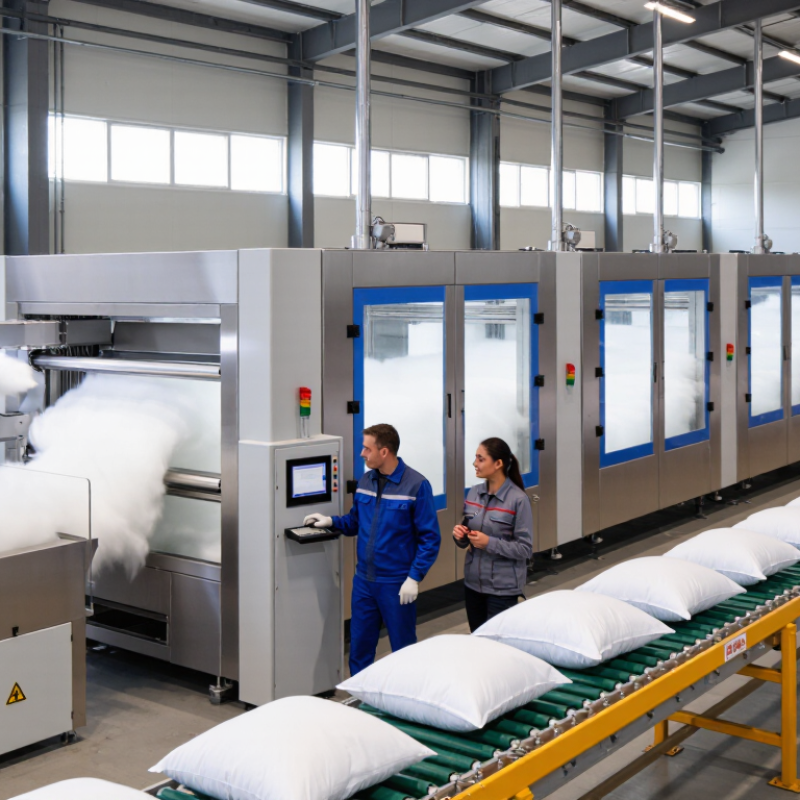
How Fiber Opening and Pillow Filling Machines Process Materials
Fiber opening and pillow filling machines begin by loosening compressed fiber into a workable, airy mass. Feed rollers meter the material toward opening rollers or toothed cylinders, which separate clumps without excessive cutting. Too much speed can shorten delicate fibers. Too little leaves stubborn knots. The opened stock may pass through screens or air separators to remove loose debris, then travel through ducts to a weighing hopper and filling nozzle. Small details matter.
Textile Exchange’s Materials Market Report 2024 estimates global fiber production reached 124 million tonnes in 2023. USDA’s Cotton: World Markets and Trade report also tracks substantial cotton production worldwide. These figures reflect varied material streams, not pillow-filling demand specifically; that distinction matters when sizing equipment. Cotton, polyester staple, and recycled blends behave differently under airflow and mechanical opening. Operators should check fiber length, moisture, dust, and static before adjusting feed rates. A pillow that feels uneven may point to inconsistent weighing, not just poor opening. There is no perfect setting for every batch. Trial runs help, though they take time and material.
Key Machine Types and Their Production Functions
Fiber-opening and pillow-filling lines handle different stages of production. Bale openers loosen compressed fiber into smaller tufts, while fine openers reduce clumps before blending. A blending chamber can combine polyester fiber with recycled or natural fibers. The goal is an even feed, not simply maximum speed. Small clumps can leave visible lumps inside a pillow.
Textile Exchange’s Materials Market Report 2024 estimated that global fiber production reached 124 million tonnes in 2023 and could reach 160 million tonnes by 2030 if current trends continue. This figure describes the wider fiber market, not pillow-machine sales. Still, it points to growing pressure for consistent processing. After opening and blending, a pillow-filling machine meters fiber into shells through a filling tube. Some setups use scales to control fill weight; others rely more on operator adjustment. That difference matters. Uneven filling can change pillow loft and feel.
Tips: Test with your actual fiber blend. Check for dust, clumps, and weight variation across several pillows. Keep a sample from each run. It is easy to overlook a small setup issue. A faster line may not produce a better pillow.
Top 10 Fiber Opening and Pillow Filling Machines for Buyers
Key machine types and their typical production functions
This functional map shows common roles in fiber-processing and pillow-production lines. A value of 1 means the machine commonly performs that function; 0 means it is not its primary function. It compares functions, not production capacity or machine rankings.
Top 10 Fiber Opening and Pillow Filling Machines
Top 10 fiber opening and pillow filling machines cover different stages, from compressed bales to finished cushions. A typical selection includes a bale opener, coarse opener, fine opener, fiber blender, dust extractor, carding machine, reserve hopper, weighing feeder, pneumatic conveyor, and pillow filling machine. Each has a distinct job. The bale opener loosens dense fiber, while the fine opener helps separate clumps before filling.
Match the equipment to the fiber type and daily output, not just the advertised speed. Ask how operators clear jams, adjust feed rates, and clean the machine between materials. Check the filling head, too. A narrow nozzle may slow production when pillow openings are small, while an oversized one can make handling awkward. Small details matter. Review noise, dust control, and access to wear parts during a site visit, if possible.
A short production trial can reveal uneven fill weights or fiber escaping around the nozzle. Record these issues instead of relying only on a smooth demonstration. Ask for measured output using your own fiber, since moisture and fiber length can affect feeding. One weak point is easy to overlook: a strong filling machine cannot compensate for poorly opened fiber upstream. Also, real lines are rarely perfect; operators may need to pause and adjust settings as batches change.