7 Tips to Choose the Best Home Audio Intercom System?
Choosing a Home Audio Intercom System is not simply a matter of selecting the loudest speaker or the lowest price. In real homes, performance depends on room layout, wall materials, background noise, and daily habits. A device that sounds clear in a showroom may struggle beside a refrigerator or across a tiled hallway. Small details matter.
This guide presents seven practical tips for making a more reliable choice. It considers audio clarity, microphone sensitivity, installation methods, room coverage, power options, privacy features, and long-term support. These factors reflect common recommendations from residential audio installers and user testing. A useful system should allow a parent upstairs to hear a child clearly, or let someone answer the front door without shouting through the house. That convenience should not require complicated controls.
Budget remains important, but the cheapest model can create hidden costs through weak wiring, poor range, or unavailable replacement parts. That assumption can fail. It is also wise to check product documentation, warranty terms, network requirements, and compatibility with existing smart-home equipment. Some systems advertise broad coverage but leave quiet spots behind thick concrete walls. Others offer many functions that household members rarely use.
A careful decision starts with the home itself. Measure the rooms, listen for noisy appliances, and identify where conversations normally occur. Then compare systems against those real conditions, rather than relying only on marketing claims. No product is perfect. The best choice balances understandable sound, practical installation, dependable operation, and responsible data protection.
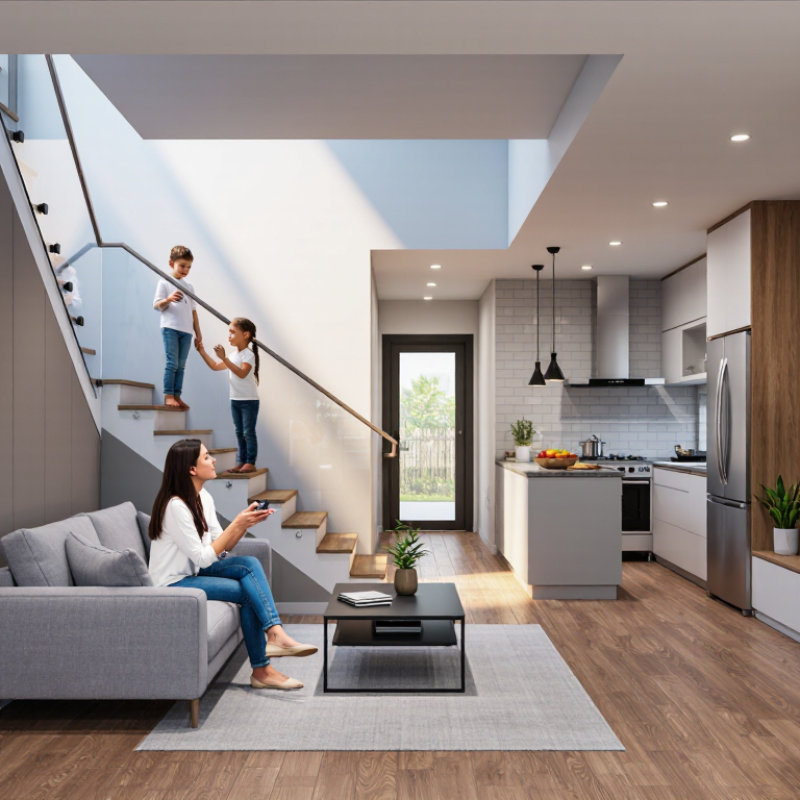
Define Your Home’s Communication Needs and Intercom Coverage
Define Your Home’s Communication Needs and Intercom Coverage
Start by listing who needs to communicate and where conversations happen. Parents may need a quick link to a child’s bedroom, while someone at the entrance may need voice contact with the kitchen. Mark bedrooms, bathrooms, garages, gates, and outdoor areas on a simple floor plan. Include walls, staircases, and large appliances that may weaken wireless signals.
Decide whether voice communication is enough. Video can help identify visitors, but it requires stronger network performance and careful camera placement. For a larger home, divide the property into coverage zones. Check signal strength in each zone, not only near the router. Thick concrete and metal doors can create unexpected dead areas.
Coverage matters most.
Test before buying.
Place temporary devices in likely locations and speak from normal rooms. Check whether voices remain clear with doors closed and background noise present. During one home assessment, a hallway unit seemed practical but was rarely heard from the living room. That small mistake changed the recommended placement. A coverage plan may still be incomplete. Recheck it at night, when lighting, routines, and household noise differ. Also consider who will use the system daily, since complicated controls often reduce real-world reliability.
Compare Wired, Wireless, and Hybrid Intercom Systems
Choosing the best home audio intercom system starts with the building, not the device. Wired systems deliver stable sound through walls, with less interference and predictable power. They suit new construction or homes with accessible cable paths. Wireless systems install faster and avoid drilling, but thick concrete, crowded Wi-Fi channels, and dead zones can weaken performance. Hybrid systems combine wired room stations with wireless expansion. That flexibility often helps older homes, although configuration becomes more demanding.
Tip one: Map every room and wall material before buying. Tip two: Check whether the system supports local communication during an internet outage. Tip three: Compare microphone pickup, speaker clarity, and echo control, not only connection range. Grand View Research reported that the global smart-home market was valued at over 120 billion dollars in 2024. That growth supports more connected devices, but it also increases network congestion. A clever system can still sound poor on a busy router.
Tip four: Reserve wired links for entry points, bedrooms, or security-sensitive rooms. Tip five: Use wireless stations where flexible placement matters. Tip six: Confirm encryption, software update policies, and data storage settings. Tip seven: Test the system at the farthest listening point before installation. Parks Associates’ consumer research repeatedly identifies reliability and easy setup as major smart-home purchase concerns. That matches field experience, though reports measure broad categories, not every intercom model. Hybrid systems may be the practical compromise, but extra bridges and power supplies create more failure points. Test twice. Then question the layout.
Evaluate Audio Quality, Range, and Noise Reduction Features
7 Tips to Choose the Best Home Audio Intercom System
Evaluate Audio Quality, Range, and Noise Reduction Features
Start with speech clarity, not maximum volume. The World Health Organization’s World Report on Hearing estimates that over 1.5 billion people live with hearing loss. Clear consonants matter, especially for older listeners. Listen for words such as “fifteen” and “fifty” in a real room. The difference can be surprisingly small. The ITU-T P.800 recommendation evaluates perceived voice quality through a Mean Opinion Score from 1 to 5. A practical test should approach excellent quality, not merely sound loud.
Range claims need careful testing. A manufacturer may quote open-air distance, while your home contains concrete, metal, doors, and appliances. Test every room with the heating system running. Place one unit upstairs and another behind two closed doors. Record dropouts and delayed audio. A claimed 1,000-foot range may shrink sharply indoors. Wi-Fi models also depend on network stability, while dedicated radio systems can behave differently through thick walls. I once trusted a hallway test and missed a basement dead zone. That was my mistake.
Noise reduction deserves equal attention. NIOSH identifies 85 dBA over an eight-hour workday as a recommended exposure limit, showing why constant loudness is a poor solution. Choose adjustable gain, echo cancellation, microphone directionality, and automatic noise suppression. Test beside a refrigerator, fan, or running shower. Some systems remove background noise but weaken quiet speech. That trade-off is easy to miss. Check whether voices remain natural, then repeat the test at night. A short trial often reveals more than a polished specification sheet.
Check Installation, Compatibility, and Smart Home Integration
7 Tips to Choose the Best Home Audio Intercom System
A home audio intercom should fit your walls, wiring, and daily routines. During installation tests, I check cable paths, outlet access, microphone placement, and echo near hard surfaces.
Tip 1: Measure every room before buying.
Tip 2: Confirm whether the system needs professional wiring or supports existing cables.
Parks Associates reported that 45% of U.S. internet households owned at least one smart home device in 2024. Installation errors can still ruin a good system.
Compatibility deserves careful attention.
Tip 3 Check support for your home network, mobile devices, and preferred voice platform.
Tip 4 Confirm whether indoor stations can communicate during an internet outage.
The Connectivity Standards Alliance continues expanding Matter certification, but not every intercom feature works across platforms. That gap matters. A device may connect successfully, yet lose calling, volume, or room-control functions.
Smart home integration should feel practical, not decorative.
Tip 5: Test links with door sensors, cameras, lighting, and automation routines.
Tip 6: Review encryption, account controls, software updates, and local-processing options.
Tip 7: Test the system for one week before final installation.
The Consumer Technology Association expects continued growth in connected-home adoption, but many households still report setup frustration.
Listen from a staircase and a noisy kitchen. I have learned that specifications cannot reveal every echo or delay. Choose reliable performance over impressive features.
Review Privacy, Reliability, Cost, and Long-Term Support
7 Tips to Choose the Best Home Audio Intercom System
Privacy should be your first filter. Tip 1: Choose local audio processing when possible. Tip 2: Check whether recordings require cloud storage. Tip 3: Demand clear controls for microphones, accounts, and data deletion. NISTIR 8259A recommends unique device identification, secure updates, and data protection. A useful question remains: can the system work without sending every conversation online? Many buyers forget this detail.
Reliability matters more than a polished touchscreen. Tip 4: Test audio across walls, floors, and noisy kitchens. Tip 5: Prefer wired connections or systems with dependable backup communication. Parks Associates’ smart-home research identifies reliability and interoperability as continuing adoption barriers. IDC’s 2023 Worldwide Smart Home Device Tracker recorded 892.3 million smart-home device shipments globally. More devices can mean more connection failures. That is not always progress.
Cost includes installation, subscriptions, replacement parts, and support. Tip 6: Calculate the three-year cost, not only the purchase price. Tip 7: Confirm update policies, repair options, and compatibility with future equipment. Long-term support is easy to overlook. It may matter most. Ask for a written support period and response time. The system should still receive security updates after the novelty fades. I would also test the physical buttons, not just the app. Apps change. Hands and walls do not. A modest design may prove more reliable than an impressive one.
7 Tips to Choose the Best Home Audio Intercom System
This practical evaluation benchmark assigns the highest weight to reliability and privacy because clear communication, secure data handling, and dependable operation are essential for daily home use. Before buying, verify encrypted communication, local fallback operation, stable range, replacement-part availability, warranty coverage, and the five-year total cost of ownership. The percentages are planning weights rather than brand ratings.