Sesame White Granite is often selected for its pale background, fine dark flecks, and practical versatility. Yet photographs can hide meaningful differences. A slab under showroom lights may look warmer than one installed beside a cool-white kitchen wall. Buyers comparing China’s suppliers should examine quarry origin, block consistency, finishing options, and documented quality controls.
The U.S. Geological Survey’s annual Mineral Commodity Summaries tracks dimension-stone production and trade, offering a useful framework for evaluating supply rather than relying on appearance alone. USGS mineral commodity specialist Robert D. Crangle Jr. has reported on the dimension-stone sector. A sourcing principle paraphrased from that reporting is: “Assess stone through its supply, specifications, and intended use—not color alone.” This is a paraphrase, not a verbatim quotation. Ask for current test reports, clear close-up images, and sample pieces from the same production batch. Small checks matter.
This guide introduces ten Sesame White Granite suppliers in China and the questions buyers can use to compare them. Supplier rankings are not a substitute for independent verification. Product names may also vary between sellers, so confirm the stone’s identity and finish in writing. No list can capture every project need. A careful review of samples, packing details, lead times, and after-sales support can reduce surprises once the crates arrive.
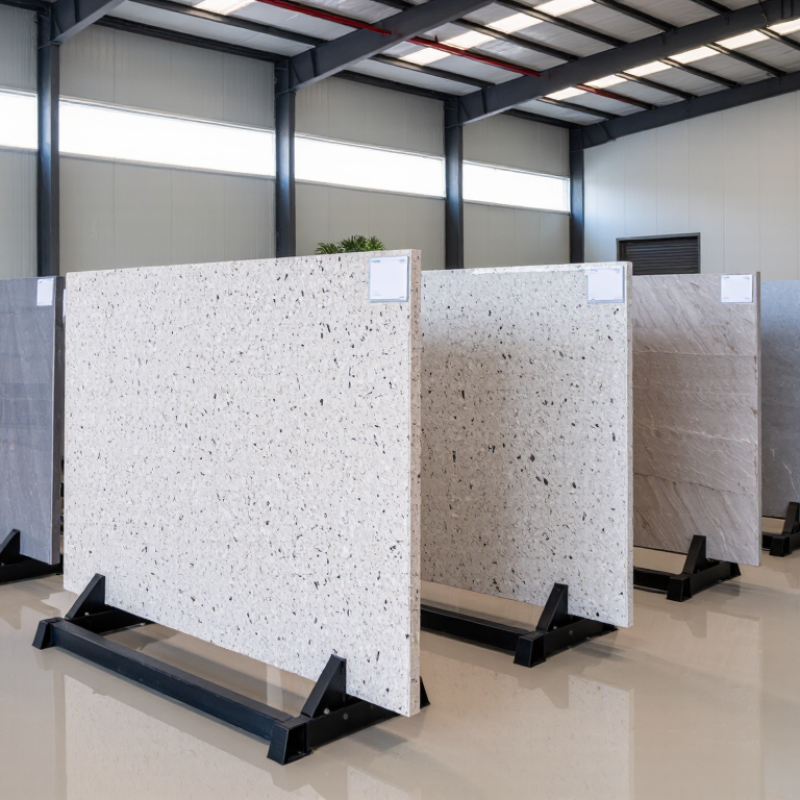
Sesame White Granite is a commercial name for a light gray granite flecked with white, charcoal, and occasional dark mineral grains. Its fine, evenly scattered pattern can resemble sesame seeds. In a freshly cut slab, the crystals catch light subtly; wet stone often looks darker and more contrasted. The name is not a precise geological classification, though. Color and grain size vary by quarry bench, so samples matter.
In China, material sold as Sesame White is commonly associated with Fujian Province, including quarrying areas around Zhangzhou. Confirm the exact quarry and block origin with the supplier, because similar trade names can refer to different stone. Ask for current quarry documentation and inspect a sample against the finished surface. A small sample can mislead. The U.S. Geological Survey’s Mineral Commodity Summaries 2024 estimated U.S. dimension-stone production at about 2.4 million tons in 2023, valued at roughly $470 million. That figure covers the broader U.S. dimension-stone sector, not Sesame White specifically, but shows the scale of the natural-stone market. For practical selection, compare slabs in daylight and check absorption, finish consistency, and batch variation before specifying the stone.
Sesame White Granite is valued for its pale gray-white background and scattered dark mineral grains. The pattern resembles fine pepper across a light surface, though individual slabs can vary noticeably. Quartz and feldspar contribute to its hardness, while natural mineral variation gives each batch a slightly different look. That variation is real. Check several slabs together before approving a large order.
The stone is commonly used for kitchen counters, flooring, stairs, wall cladding, and outdoor paving. A polished finish brings out the grain and is easy to wipe clean; flamed or brushed finishes offer more texture underfoot. For wet areas, ask for the supplier’s test data and confirm the finish suits the intended use. Sealing needs can depend on the stone and the installation. Test a sample. One detail is easy to overlook: pale stone may show dark spills or dust more clearly than expected, so maintenance habits matter as much as appearance.
Sesame white granite is commonly used for countertops, flooring, wall cladding, stairs, and paving. The ratings show relative suitability on a qualitative 1–5 scale, considering typical durability and use; they are not laboratory measurements or market-share data. Actual performance depends on the stone grade, finish, installation, and maintenance.
Assessing a sesame white granite supplier begins with traceability, not a polished brochure. Ask which quarry or processing region supplied the stone, and request current product photos, sample labels, and written lot details. A small sample is useful, but it cannot show every variation across a full shipment. Look closely. Compare several slabs under daylight and indoor lighting; flecks, background tone, and veining can shift between blocks. Ask for proof. Request test reports for properties relevant to your project, such as water absorption and flexural strength. Check the report date and sample identification. A report is not a guarantee for every shipment.
Review production control and communication. Confirm thickness tolerance, surface finish, edge treatment, and acceptable variation in writing. Ask how slabs are inspected, photographed, packed, and protected from corner damage. For a large order, approve a representative mock-up before fabrication. Record the lot number and keep a sample if practical. Speak with past buyers about delivery accuracy and how problems were handled, not just appearance. A site visit can help, though it may show an unusually tidy day. I would not judge a supplier by one perfect slab. Compare the full range, the paperwork, and the answers to specific questions. If an answer stays vague, pause and ask again.
China’s Top 10 Sesame White Granite Suppliers
A useful comparison of China’s top 10 sesame white granite suppliers starts with quarry consistency, not brochure claims. Sesame white can vary between batches: some slabs show tight grey speckles, while others contain warmer grains or darker mineral flecks. Ask for photographs of current production, plus a retained sample tied to the shipment. Small details matter.
Trade data needs careful reading. UN Comtrade classifies granite under HS 2516, including crude or roughly trimmed granite (2516.11) and granite merely cut or sawn (2516.12). These codes do not identify sesame white by name, so they cannot independently verify a supplier’s ranking or specialty. The USGS Mineral Commodity Summaries 2024 also reports dimension stone by production and value, rather than by commercial color name. That is a real limitation.
For each of the ten candidates, compare slab thickness, finish, packing method, and documented test results. Request water-absorption and compressive-strength figures, and check that the report names the tested material and method. A polished sample may look convincing under showroom lights. It may look different outdoors. I would not treat a low quote as proof of efficiency; inconsistent sorting can create costly waste, and I have seen this overlooked. Ask for a clear defect allowance and replacement process before approving a container.
When comparing China’s sesame white granite suppliers, judge the stone and the service separately. Color can shift from cool gray to warm cream, and mica flecks vary between blocks. Ask for slab photos under neutral light, recent batch samples, and the quarry or block reference. Small detail, big difference. The USGS Mineral Commodity Summaries 2024 estimated U.S. dimension-stone production at about 1.4 million tons in 2023, illustrating a substantial, internationally traded sector. For technical checks, request test reports showing water absorption, density, and flexural strength; compare results with the project specification and relevant ASTM requirements. A polished sample is not a guarantee of a consistent shipment.
Compare quotations on the same basis: grade, thickness, finish, tolerances, packing, and Incoterm. A lower price may exclude fumigated crates, inspection, or inland transport. Ask suppliers to itemize these costs and state lead times in writing. Export capability also means clear packing lists, commercial invoices, crate markings, and shipment photographs before loading. Request references for similar overseas orders, but verify them independently. A neat spreadsheet can still conceal a weak batch. I would treat vague claims like “premium quality” as an unanswered question, not evidence. Check whether the supplier can arrange pre-shipment inspection and replace damaged or out-of-spec pieces under agreed terms.
Data note: Supplier-specific rankings, prices, test results, and export capabilities cannot be verified from the information provided. The anonymous rows below are comparison slots, not identified companies or claims about actual suppliers. Request current quotations and supporting documents before making a purchasing decision.
| Comparison slot | Quality evidence to request | Pricing basis to compare | Export-service checks | Verified supplier-specific data |
|---|---|---|---|---|
| Supplier 1 | Request a recent test report for the offered stone lot. Relevant ASTM methods include C97/C97M for absorption and bulk specific gravity, C170/C170M for compressive strength, and C880/C880M for flexural strength. | Quote required; compare the same product form, thickness, finish, quantity, and delivery term. | Confirm export packing, shipping documents, port of loading, and proposed Incoterm in writing. | Not independently verified. |
| Supplier 2 | Ask for slab or tile dimensions, thickness tolerances, finish details, and photos of the actual production lot; verify test reports against the quoted material. | Quote required; request separate itemization for stone, processing, packing, and freight where applicable. | Confirm whether fumigated or otherwise compliant wooden packing is available when required by the destination market. | Not independently verified. |
| Supplier 3 | Request samples and written acceptance criteria for color range, veining, surface finish, edge quality, and allowable natural variation. | Quote required; confirm currency, validity period, minimum order quantity, and whether the price is per square metre, slab, or other unit. | Confirm availability of a packing list, commercial invoice, and bill of lading or other agreed transport document. | Not independently verified. |
| Supplier 4 | For dimension stone, ask whether the product is specified against ASTM C615/C615M and obtain the applicable product specification and test documentation. | Quote required; compare like-for-like finish, thickness, dimensions, edge processing, and order volume. | Request estimated production time, shipment schedule, and details of how delays or damaged cargo are handled. | Not independently verified. |
| Supplier 5 | Check whether the supplier can provide lot identification and inspection records linking the delivered material to the approved sample. | Quote required; clarify taxes, duties, inland transport, ocean freight, and insurance inclusions or exclusions. | Confirm the offered Incoterm and named place or port; do not compare offers with different delivery responsibilities as equivalent. | Not independently verified. |
| Supplier 6 | Request inspection criteria for flatness, squareness, calibration, surface defects, and finish consistency, tailored to the intended application. | Quote required; ask whether sample, inspection, and special packing costs are included or charged separately. | Ask for loading photos, crate or bundle counts, gross and net weights, and container-loading records if available. | Not independently verified. |
| Supplier 7 | For relevant applications, request test results for the properties specified in the project documents; use the applicable standard and acceptance limits agreed by buyer and seller. | Quote required; obtain a written quotation with product description, quantity, unit, payment terms, and quotation validity. | Confirm communication contact, document turnaround, shipment tracking arrangements, and post-shipment support. | Not independently verified. |
| Supplier 8 | Request a pre-shipment inspection or agree on an independent inspection procedure, sampling method, and acceptance criteria before production. | Quote required; check whether volume discounts or mixed-size loading are offered for the specific order. | Verify destination-specific document requirements with the buyer's customs broker before shipment. | Not independently verified. |
| Supplier 9 | Compare approved control samples with production material under consistent lighting; record agreed limits for natural color and pattern variation. | Quote required; confirm payment schedule, deposit terms, balance timing, and any charges for changes or cancellations. | Confirm the supplier's responsibility for export clearance and the specific shipping documents included in the offer. | Not independently verified. |
| Supplier 10 | Require written product identification, agreed inspection standards, and supporting quality records before approving bulk production. | Quote required; evaluate landed cost using the same order specification, delivery term, and destination for every offer. | Confirm the proposed shipping route, estimated transit time, packing method, and process for reporting transit damage. | Not independently verified. |
Practical comparison rule: Compare written offers only after the stone specification, finish, dimensions, quantity, inspection requirements, destination, and delivery term are aligned. ASTM method references identify test methods; they do not establish supplier-specific performance or guarantee suitability for a particular project.
Build your system. Protect your boat. Join the movement.