China’s electric water heater market brings together household brands, specialist manufacturers, and export-focused suppliers. Comparing them takes more than checking product prices. Buyers also need to consider heating efficiency, tank materials, safety controls, after-sales support, and suitability for local water conditions.
The International Energy Agency’s 2022 report, The Future of Heat Pumps, estimates that heat pumps could reduce global carbon dioxide emissions by at least 500 million tonnes in 2030 under announced climate pledges. That figure concerns heat pumps broadly, not every electric water heater. Still, it helps explain why efficient water-heating technologies are drawing greater attention. IEA Executive Director Fatih Birol has described heat pumps as “a key technology for decarbonising heating.” This is relevant context, though not a ranking of Chinese manufacturers.
The companies covered here include established names such as Haier and Midea, alongside other manufacturers serving domestic and international markets. Their products can differ sharply in capacity, heating method, controls, and warranty terms. Details matter. A compact unit for a city apartment has different demands from a large storage heater serving a busy hotel. Manufacturer claims also deserve careful checking against product specifications and independent test data. Some rankings look precise, but their criteria may be hard to compare. That is a real limitation. This guide therefore focuses on practical evidence and market presence, helping readers identify which Chinese manufacturers merit closer evaluation.
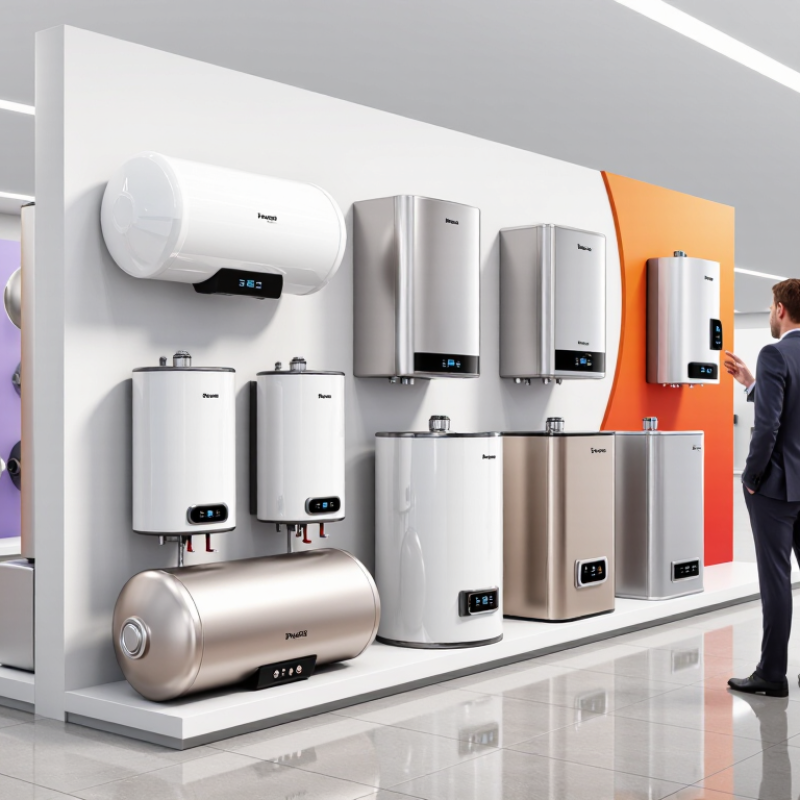
China’s electric water-heater industry is a layered supply chain, not simply a group of assembly plants. Upstream suppliers produce enamelled steel tanks, heating elements, thermostats, insulation, valves, and safety controls. Manufacturers combine these parts into storage models for homes and apartments, while other producers focus on compact, point-of-use units. Small details matter. A mismatched thermostat and tank can affect performance more than an attractive outer casing.
Demand comes from both new housing and replacement purchases. The National Bureau of Statistics’ 2023 Statistical Communiqué reported that real-estate floor-space starts fell 20.4%, while completed floor space rose 17.0%. These figures track housing, not heater shipments, but they help explain why suppliers serve both construction projects and household upgrades. Sales move through appliance retailers, online platforms, installers, and property contractors, each with different delivery and service needs. Installation space and local water pressure can also influence product choice. It is uneven. Public statistics do not always isolate electric water heaters from broader appliance categories, so comparisons between manufacturers need a clearly stated source and reporting year.
A leading Chinese electric water heater manufacturer is not defined by output alone. It must deliver dependable hot water, day after day. The International Energy Agency reported that buildings account for about 30% of global final energy use and 26% of energy-related emissions (IEA, 2023). That makes efficiency more than a sales claim. Look for published test methods, verified energy-label data, and stable performance across inlet-water temperatures. Small details matter: tank insulation, heat-loss rates, recovery time, and thermostat accuracy. A showroom cannot prove them.
Manufacturing depth matters too. Strong producers control welding, corrosion protection, pressure testing, and final electrical-safety checks. Ask how each production batch is sampled, how failures are recorded, and whether spare parts remain available years later. Service response matters. Check warranty terms and technician coverage, not just factory size. China’s market is large, but scale alone does not demonstrate leadership. I would treat any single efficiency figure cautiously: installation, water hardness, and household demand can change real-world results.
| Leadership Dimension | Relevant Benchmark or Fact | Evidence to Check When Comparing Manufacturers |
|---|---|---|
| Energy efficiency | China’s GB 21519-2023 standard sets minimum energy-efficiency requirements and efficiency grades for storage electric water heaters. Grade 1 represents the highest efficiency grade in the system. | Current test reports, the applicable efficiency grade for each model, and consistency between the tested model and the product being sold. |
| Product safety | Electric water heaters are subject to product-specific electrical safety requirements. Requirements and certifications can differ by product type and sales market. | Valid safety test reports, applicable Chinese conformity documentation, and destination-market approvals for export models. |
| Manufacturing capability | Production capacity alone does not establish product quality or market leadership. Capacity and utilization should be assessed for the relevant product category. | Audited production figures, factory capability, quality-control procedures, and evidence that stated capacity applies to electric water heaters. |
| Product range | Storage and instantaneous electric water heaters have different designs and performance requirements; comparisons should be made within the same product type. | Current model catalogue, rated capacity or flow rate, rated power, intended installation type, and clearly stated model specifications. |
| Reliability and durability | Service life depends on design, installation, water conditions, and maintenance; a warranty period by itself is not proof of long-term reliability. | Warranty terms, documented product testing, failure-rate data where available, and access to replacement parts and repair services. |
| Quality management | A documented quality-management system can support consistent manufacturing, but certification should be checked for scope, validity, and issuing body. | Current certificates, factory audit records, incoming-material controls, end-of-line testing, and procedures for handling product recalls or defects. |
| After-sales support | Service coverage is a practical indicator of how well a supplier can support domestic customers, distributors, and export markets. | Service-network coverage, repair response commitments, spare-parts availability, and written warranty and returns policies. |
| Export readiness | Compliance requirements vary by destination, so a certificate for one market should not be assumed to satisfy another market’s rules. | Market-specific certificates, multilingual technical documentation, product-label compliance, and a record of experience in the target market. |
| Transparent performance claims | Comparable, model-specific data is more useful than broad claims about being a leading or top manufacturer. | Tested energy use, heating performance, rated electrical details, clear model identification, and supporting documents that can be independently verified. |
| How to identify a leader | A credible comparison ranks verified products and capabilities—not unsupported company-wide claims. | Compare manufacturers using the same product type, applicable standards, current documentation, service requirements, and independently verifiable evidence. |
China’s electric water heater supply base includes integrated appliance manufacturers, specialist water-heating producers, and contract factories serving domestic and overseas buyers. Their main products are storage-tank units and tankless electric models. Some also make heat-pump water heaters, a separate technology that should not be confused with resistance-heating products.
Scale matters, but sector-wide figures do not identify individual heater makers. The China Household Electrical Appliances Association’s 2023 industry report put revenue for China’s entire household-appliance industry at about 1.84 trillion yuan. That figure shows the depth of the wider manufacturing ecosystem, not electric water heater sales alone. A careful comparison should therefore check factory audits, product certifications, annual capacity by model, and quality-control records rather than rely on broad industry totals. Details matter.
For storage models, inspect tank welding, enamel coverage, insulation thickness, and thermostat testing. For tankless units, check heating-element consistency, flow-rate testing, and temperature stability under changing water pressure. Ask whether quoted capacity refers to one factory or several subcontractors. That distinction can affect lead times. Public data rarely supports a definitive manufacturer ranking, and export volume alone does not prove durable product performance. A supplier’s test records and sample consistency offer more useful evidence.
Representative rated electrical input varies by heater type: storage models commonly use about 2.0 kW, heat-pump models about 0.8 kW, and instant models about 8.5 kW. These are illustrative product ratings, not manufacturer rankings or market-share figures; specifications vary by model.
China’s electric water heater manufacturers differ less by headline capacity than by heating method, insulation, controls, and serviceability. Resistance models heat water quickly and suit compact bathrooms, but their efficiency depends heavily on tank insulation and standby losses. Heat-pump models draw warmth from surrounding air, so installation space and ambient temperature matter. The U.S. Department of Energy reports that heat-pump water heaters can be two to three times more energy-efficient than conventional electric-resistance units. That gap matters.
Product comparisons should include more than rated efficiency. Check recovery time, usable hot-water volume, tank lining, corrosion protection, and noise. A larger tank may help a busy household, yet it also needs more floor space. Smart controls can schedule heating around household routines, but their value depends on clear settings and reliable connectivity. Small details count.
The International Energy Agency’s 2022 report, The Future of Heat Pumps, describes heat pumps as a key route to more efficient heating; its broad findings are not a guarantee for every water heater. In practice, compare test conditions and local efficiency labels before comparing figures. Installation quality can change real-world performance, especially for heat-pump units with limited airflow. That part is often overlooked.
A reliable manufacturer should fit the heater to its intended use, not simply offer the largest catalog. Ask for rated capacity, recovery time, tank material, insulation thickness, and operating pressure in writing. These details matter in a hotel utility room and a compact apartment alike. Small omissions become costly.
Review production controls and request test records for the exact model under consideration. A factory visit can show how incoming components are checked and whether finished units receive routine inspections. Ask how defects are logged and resolved. A polished brochure is not proof. Check warranty coverage, spare-part availability, and expected response times; vague promises can be difficult to use when a unit fails.
Confirm that certifications and test evidence match both the model and the destination market. Compare quotations line by line, including packaging, accessories, and after-sales support. A low price may exclude items you assumed were included. Communication is another practical test: can the supplier answer technical questions clearly and provide revised documents promptly? It is easy to overvalue price and underweight service. Even experienced buyers can miss a small clause. Before placing a large order, review a sample unit and record any changes needed.
Build your system. Protect your boat. Join the movement.